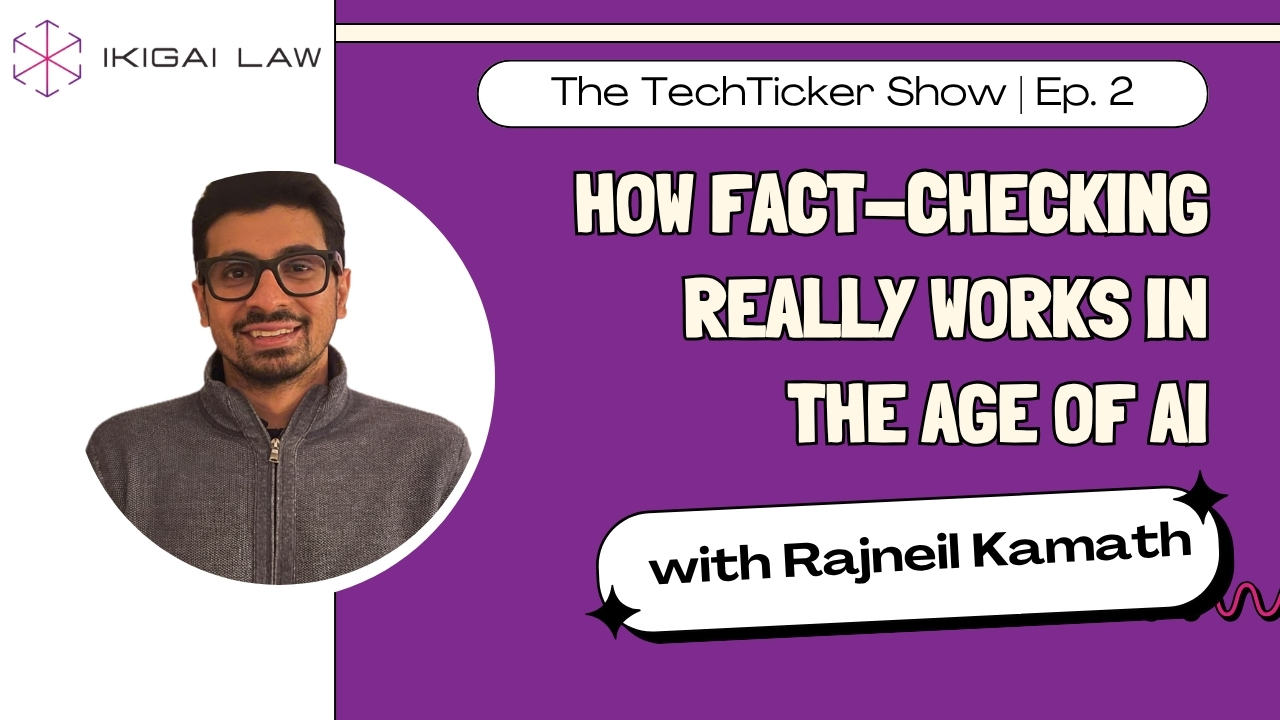
In the second episode of The TechTicker Show, Nirmal Bhansali speaks to Rajneil Kamath, publisher of Newschecker and Vice President of the Trusted Information Alliance (TIA), about how fact-checking works and what AI has changed.
Rajneil points out that people were being misled long before AI, often through real videos shared with the wrong context. Misinformation is far more layered than the question of whether something is AI or not. He also talks about India's new rules on labelling AI-generated content and where labelling might go from here. There's a lot more in the episode.
Watch the full video here, or read the entire transcript below.
Transcript of the Episode
Note: This transcript has been lightly edited for clarity and readability.
Nirmal Bhansali — 00:00
Hi, I'm Nirmal Bhansali, and welcome to the TechTicker Show. My guest this time is Rajneil Kamath, someone who's worn many hats. He's been a public policy professional, a media entrepreneur and a creator. He works closely on misinformation. He's the Vice President of the Trusted Information Alliance and the publisher of Newschecker.
In this episode, we get into how a fact-check really works and the day-to-day operations of these organisations. We also ask whether AI has made misinformation worse and what the future really holds for trust online.
Nirmal Bhansali — 00:34
Welcome to the TechTicker Show. Thank you so much for being here. Really glad we could speak.
Rajneil — 00:39
It's wonderful to be here, Nirmal. Thank you for having me. I'm super excited to be speaking with you.
Nirmal Bhansali — 00:45
I think the simple place I want to start is with my own experience. I used to work briefly in a small media newsroom as well. I was at Splainer, where I was a news editor. Our job was, in some ways, similar to what you would do at The Signal: a lot of curation.
One of the things we had to do was ensure that everything we wrote was absolutely true and verified, and that we weren't making mistakes, because that's what people came to us for. But my sense, at least when I had just started, was that I didn't really understand fact-checking as a process beyond, okay, let's look for two or three sources. If everyone is saying the same thing, then it must be true.
You've now been heading a network of fact-checkers, and you run your own organisation, Newschecker. I want to start by having you break down what the day-to-day operations of a fact-checking organisation actually look like. What does the team do? What does the day-to-day look like?
Rajneil — 01:52
I'm the publisher at Newschecker. Newschecker currently publishes in more than 10 languages across India, Nepal, Bangladesh and Sri Lanka. I also serve as the Vice President of the Trusted Information Alliance. There's a President, Rakesh Dubbudu, who is also the founder and publisher of Factly, based out of Hyderabad.
You're right. In many ways, when you're thinking about fact-checking, you want to talk to sources and make sure that the story checks out.
The difference is that, in most traditional publications, you don't necessarily need to name your sources. In fact-checking, we need named sources, which means people who are willing to go on the record and tell you that something has happened.
So a typical fact-checking process involves two primary sources and one secondary source, but both primary sources have to be named and willing to go on the record.
That's where a lot of the difference lies. Let me start by saying: what does the day of a fact-checker look like? Well, not every day is the same.
Rajneil — 03:02
If you're in a professional fact-checking role, you have to keep yourself updated on what's going on in the world. Not merely in your country, state or city. You need to know what's going on globally because that gives you good context about what you can expect to happen.
When you've been a fact-checker for a while, you'll realise that if there is a military conflict somewhere in the world and it's currently raging, you could see a lot of footage claiming to be from that conflict that might actually be gaming footage, for example.
Or take a natural disaster. It's unfortunate, but you have to ask what kind of misinformation could start spreading around it. So you're not only keeping track of events, you also have to anticipate what's going to happen.
You're keeping track of what's going on in the world, in your country, in your state and in your city. You're following a list of people who you know are newsmakers, and another list of people who you know are what we call super-spreaders of misinformation. Sometimes they know they're doing it, and sometimes they do it knowingly.
Whenever they say something or share something, you first try to understand whether it is an opinion or whether they are trying to pass something off as fact. What they're trying to pass off as fact is what you actually go and check.
You do your preliminary checks and get a sense of what this person is saying, whether it checks out or not. The moment it doesn't check out, a larger investigation process starts.
Fact-checking can involve checking what a person in a position of power or influence has said. It could also mean looking at a piece of evidence shared online by somebody, whether they're in a position of power or not, especially if that evidence is going fairly viral. You want to know whether the incident or issue is really there or not.
And then you start your day. You're identifying what we call claims, which you then go and fact-check.
As I mentioned, every claim typically requires two primary sources and one secondary source. The process can also involve tools. Sometimes you may do a simple reverse-image search to see whether an image that was shared has been shared previously.
It's a combination of tools, calling people on the ground and checking, going through historical data to see whether certain things are there, and then piecing the entire story together. You write the fact-check and explain each step very methodically so that anybody reading it, if they were to replicate the same steps, would arrive at the exact same conclusion that we did.
Of course, for this we assume there is one set of facts that may be true. Nowadays everybody has their own set of facts, so you also have to work through that.
Nirmal Bhansali — 06:18
I think one of the things you mentioned is that, unlike conventional journalism, fact-checking organisations in particular have higher standards. It's not just, okay, here's what a reporter said, so the fact is fine. You also need to publish the claims and the steps you've taken every single time.
I imagine this is part of the principles you're pursuing now, and everyone in your organisation has to follow them. I'm curious: is this how it works across other fact-checking organisations as well, or is it something you've developed over time?
Rajneil — 07:04
Yes, pretty much. I think it happens across all fact-checking organisations. Under the Trusted Information Alliance, we have the Fact-Checking Network for India, which has its own code of principles. Those were derived from the International Fact-Checking Network's Code of Principles, as well as the European Fact-Checking Standards Network.
We try to localise that from an Indian perspective. We subscribe to both the IFCN and the FCN standards, so this is common across fact-checking organisations.
When you're saying, we're going to tell you what the reality might be, you have to be very solid in how you present it. It's not a trust-me-bro kind of a thing. You need solid evidence.
Traditional journalistic organisations will typically run with two unknown or unnamed sources. That's not the case here. Unnamed is essentially unknown in our dictionary. We need named sources.
There have been instances where people are willing to tell us off the record that something happened, but are unwilling to go on the record. In that situation, the fact-check doesn't fly. It cannot be published because we don't have a verifiable source.
So that's really the standard we set for ourselves. And it's not just whether a politician made a statement. It's also online content.
Sometimes there might only be one source. You do a reverse-image search and it turns out the image is old, so clearly it isn't referring to a recent event. Those are the exceptions. In most instances, it's two primary sources and one secondary source.
Nirmal Bhansali — 08:58
One of the determinations you're always making is which claim to fact-check in the first place. I've gone through the Newschecker website. It's not like you've fact-checked every piece of misinformation you see on the internet or even in WhatsApp groups. There's clearly a prioritisation taking place.
Can you walk me through what that is? Is it an editorial meeting where you have a hundred claims and decide to focus on ten, or is it something different? Why certain claims and why not others?
Rajneil — 09:32
There is an editorial meeting every morning and evening. It usually starts a little after the day begins because the first part of the day goes into finding claims. Those claims are shared in the editorial meeting, and then you discuss what each of them is.
You obviously want to pick up consequential claims. By consequential, I mean those that are of public interest or extremely vital and therefore need to be addressed very quickly. It's usually one of those two things.
There are more than 20 criteria, I think, that you look at before deciding, okay, this is what I'm going to do. One, of course, is vital public interest. But anything harmful that is likely to impact law and order, a person's life, health or safety is also something we tend to prioritise and pick up early.
Usually, in Newschecker's case, we don't look at it as, what are we going to fact-check? It's a question of what will we fact-check when? Your resources are limited, so you have to decide what you fact-check first before you try to fact-check the other claims already in the queue.
Nirmal Bhansali — 10:45
Right. So it's also not a day-to-day thing. You probably have a pile of claims you're already fact-checking.
Rajneil — 10:53
Exactly. There are so many things that can come up around health, climate change, superstition and traditional medicine. It's not necessarily political in nature. Traditional medicine has a large following, and it's important to know what it can and cannot do.
In all of these instances, there are claims that you'll often find that you have to address. Again, it's not a question of whether you will fact-check them. We know we have to. It's a question of when we fact-check them and how we prioritise them in that sea of claims.
Nirmal Bhansali — 11:34
That's very interesting. But when you get to something late, and the misinformation has already spread, is that a constant tension that you have to deal with?
Rajneil — 11:48
Sometimes when you say late, I know this is a criticism of fact-checking: you guys fact-check after the claim has gone viral. But can somebody tell me how we're supposed to fact-check before the claim has been made? We're not astrologers or clairvoyants. I cannot predict what is going to come out of somebody's mouth. Somebody has to make the claim for us to fact-check it.
The second thing is: did we catch it in time or did we not? Sometimes we're very ahead of the curve and, within minutes or hours, we're able to publish the fact-check. Sometimes it really does take time.
For example, a long WhatsApp message might have 30 points. You've got to verify all 30. We've become smarter and said, out of those 30 points, we've managed to fact-check two, and two of them definitely turned out to be false. So be careful before you forward all 30. We'll come to the remaining 28, but it's going to take time to go through those as well.
At least we managed to figure out two. I think it's just a function of that.
Nirmal Bhansali — 12:55
At the end of the day, you do have a resource constraint. It's not like you can suddenly do everything.
Rajneil — 13:00
Exactly. There is a part of this ecosystem called pre-bunking, where you don't necessarily try to address a claim. Instead, you try to address the tactics that bad actors use, whether it's fear, urgency or other techniques.
The issue with pre-bunking is that you're assuming people are watching a bunch of videos, internalising them and then applying those lessons to every piece of content they see. You're asking them to look at a piece of content and think, is that person manipulating me? Is this person trying to make me angry? Is this video trying to showcase something that isn't true?
Do people use that lens when they're consuming content intentionally? Not all the time. If you are there to do research, you will know, but that's not the intent every time.
Pre-bunking is often described as inoculation, where you expose people to micro-doses of informational messaging and the effect lasts for some time before it starts wearing out. But are you going to keep doing it? I think pre-bunking is one side of media literacy and is more of a long-term solution. Fact-checking becomes the more immediate, short-term thing you can do as a claim starts spreading.
Nirmal Bhansali — 14:20
I want to move from how your newsroom, or in this case the fact-checking room, works to understanding some differences in how fact-checking happens in India compared with what your colleagues are doing in other countries.
Is it similar? I know that, in terms of principles, it's pretty much the same approach, but do you see differences in the claims you're fact-checking, which then change the way the organisations function?
Rajneil — 15:01
First, I should clarify that even at Newschecker, I'm the publisher. I'm not involved in newsroom operations.
We have a very strict Chinese wall between how I operate and how the editorial team operates.
That said, there is a lot of country-specific context. Forget countries: the way my Punjabi fact-checker thinks about things is very different from how a Tamil Nadu fact-checker thinks about things.
In Tamil Nadu, politics, culture and entertainment are very different. The people in public life are different compared with Punjab. The events that happen there are different. So the claims you're thinking about will differ according to language, region, religion, culture, politics, entertainment, education levels, awareness and the spread of digital media and internet access in each geography.
They all make a difference. Even within India, the kind of claims that different states receive can be very different.
More often than not, it will be politics. More often than not, it will be related to entertainment celebrities. And then, as events happen in real time globally, if there is an impact on you, it will show up in the claims you receive.
For example, when there was a deportation of immigrants from the US to India, that plane landed in Punjab, if I'm not wrong. It didn't happen in Tamil Nadu. That wasn't the issue being discussed in Tamil Nadu in the same way it was across a lot of North India, especially Punjab.
Those nuances exist. Because so much of this is event-based, different events dictate what kinds of claims you get.
Nirmal Bhansali — 17:05
So that also means your fact-checkers, the people operating in these places, need to be contextually relevant. I can't be expected to fact-check something happening in the Middle East as effectively as someone there.
Rajneil — 17:26
It's not that you can't, but sometimes sourcing can be hard. When we looked at the conflict happening in the Middle East, we've had to reach out to colleagues in the Middle East. There is the Arab Fact-Checking Network.
Because there's a language barrier, we may already have a post translated from one language into another. Sometimes the misinformation comes from an incorrect translation or a misinterpretation of what has been translated.
The first thing you want to do is ask an actual speaker to validate the translation and tell you whether it is accurate. Sometimes that really is the problem.
Then, if the translation is correct, you ask: can you help us verify whether this particular incident or event actually happened? Is it verifiable or not? What do we know?
In many places, as events unfold in real time, there is an information vacuum. You may not know what is going on. There is uncertainty, and that is usually when there is a flare-up of misinformation. As more and more information about an issue becomes clear, the misinformation tends to reduce.
Nirmal Bhansali — 18:41
Right.
Rajneil — 18:42
Take a military conflict. You know that two countries are bombing each other, but you don't know much else because neither side has said anything. Then people can start speculating about anything. Will it happen? Will it not happen?
Where there are information vacuums is often where misinformation starts.
There was one recently about how an Indian X account had made something about Iran's nuclear weapons, and how that somehow made its way to the Prime Minister's desk in Israel and all the way up to the US and back, while Iran had no idea what this was. That's the kind of thing you can see.
Nirmal Bhansali — 19:25
Interesting. Since you've mentioned war zones as a particular place where misinformation can spread immediately, I want to bring this into the AI context.
In our work around AI, one thing I'm noticing is that misinformation has spread rapidly. Earlier, if I was trying to verify a piece of information, I might ask whether it had been edited incorrectly, whether some claims had been changed, or whether the text was slightly different.
Now, as a news consumer, I'm constantly thinking: is this even true? Is this AI-generated? Is this a deepfake? It could be a normal piece of content or a piece of public-interest news.
How has that changed things for fact-checking organisations? You already had a huge stream of misinformation. I imagine that, in the last two or three years in particular, the volume has increased. How are you dealing with that shift? What was it like before, and what has changed?
Rajneil — 20:48
AI has definitely increased the volume of work that we have. Sometimes we're having to prove that something actually happened and it wasn't AI. Then people say, this didn't happen, this is AI. That's what they call the liar's dividend: you can deny something and say it's AI.
That is one thing we have to deal with. The volume of content has also gone up because making content has become much easier.
But I would say this again: you don't need AI to mislead people.
You can take a normal piece of footage, give it any context you want and share it. It can go viral and people can start believing it's true. It's not as if AI suddenly makes misinformation possible. If that were the case, people before AI should never have fallen for misinformation. That's clearly not the case.
AI definitely increases the volume of work because even things that may be shared as satire by the original poster using AI can very easily be misconstrued as real by somebody else who hasn't seen the original post or doesn't understand its intention.
What might be satire for you might be misinformation for a third person who receives it. From the third person's perspective, they think it is true. Person A shared it as satire. Person B received it knowing it was satire. Person C receives it, assumes it's true, starts believing it, and then sends it to Person D saying, hey, this happened. Can you believe it?
Then you have to step in and say, this is satire, it didn't happen. So once people start believing the satire, that can also become misinformation. You have to highlight those nuances as well.
Nirmal Bhansali — 22:41
Do you incorporate that into your workflows? Is AI helping you because the volume is higher? Are fact-checkers using different tools to check things faster?
Rajneil — 23:00
When it comes to synthetic media, just from a detection perspective, the creation of media has become so sophisticated that merely looking at it with the human eye may not be enough. You need certain tools to tell you whether it's synthetically generated. That's one area where there is a lot of dependence on tools.
Beyond that, AI gives us helpful tools across the spectrum, but they aren't yet used for final decision-making.
There is a lot of context in this work. There is history and there are other details that only a human has to consider before making a categorisation from a misinformation perspective.
Whether it's using Google Translate or other translation tools, or using AI to create thumbnails for our articles, AI is a helpful tool in trying to get more work done. It's definitely useful for tracking people, publications and events.
Some of us are now vibe-coding, trying to build tools that we find useful from our own workflow perspective. All of that is happening. But final decision-making still rests with a person, a real person, not an AI assistant.
Nirmal Bhansali — 24:29
There's still a human in the loop for these critical fact-checking decisions, including when you publish something.
Rajneil — 24:36
Yes. A good example is Grok. Sometimes you can take one piece of information and ask Grok three different times what that piece is, and it will give you three different explanations.
You can ask, where did this happen? Three times, and it can give you three different places. That's happened before. So you can't depend on AI to give you the answer. That judgment has to come from a human.
Nirmal Bhansali — 25:01
This is interesting. I want to take it in a slightly different direction. With chatbots on the rise, what tends to happen, at least from a consumer perspective, is that I'll see a piece of news on X and someone will tag a chatbot and say, ask Grok, ask Perplexity, ask this, is this true?
I'm seeing that as one version of fact-checking. You also now have community notes, where users of the platform are correcting claims or sharing relevant pieces of information.
The third thing that is slowly happening, not just in India but elsewhere, is that regulators and government communication agencies are also publishing fact-checks. That could be a piece of information about the government, a press release or something coming from the White House saying that what a journalist said wasn't accurate.
I'm wondering whether these trends affect the reach of Newschecker or of fact-checking organisations. And the second part is this: increasingly, I'm seeing more and more people say, here's my version of the fact-check. It's almost like a battle of fact-checkers.
Rajneil — 27:00
I don't know if it's a battle of fact-checkers or even human fact-checkers. If you're following a common process, you will arrive at the same conclusion. So there could perhaps be a battle between what you as a fact-checker say is one conclusion and what a chatbot might say is another conclusion.
Let's assume people nowadays say, ask Grok. Yes, it's an easy habit. It's a lazy way of fact-checking. You don't want to do it yourself, so you're outsourcing it to somebody else.
They may do the bare minimum check. Grok doesn't have the burden of doing two primary sources and one secondary source. Grok just needs to find another article online saying that the thing being referred to isn't true.
Ultimately, even Grok will depend on the work that fact-checkers do. If fact-checkers haven't done that job, let's say there are two people who've had a fight in a remote place in a state in India, is Grok going to call the police and ask what happened?
Is Grok going to call the victim or the perpetrator and ask what happened? Are there stringer journalists in the region? Is Grok going to call them and ask what happened? It's not going to do that. Who does that? Fact-checkers. We do the legwork and the groundwork. We publish our article.
Then Grok can tell you, yes, according to this fact-checking website, they did A and B and here's what they came up with. Or it will be very happy to tell you that it has no idea.
Nirmal Bhansali — 28:36
Yeah.
Rajneil — 28:36
If you look at community notes, a lot of notes on very obvious claims don't need to refer to a fact-check. But on more contentious claims, you'll see fact-checking links inside those community notes. Those notes would not have been written in the same way if the underlying fact-check didn't exist.
There are numbers people have put out about how many community notes contain links to fact-checks. Many times, fact-checkers themselves go through community notes and put evidence directly into the community note. But that still requires a certain amount of skill.
Nirmal Bhansali — 29:21
As far as institutions or governments setting up fact-check units are concerned, what should matter is how you distinguish between a denial and a fact-check. A denial isn't a fact-check.
Rajneil — 29:37
Many governments make this mistake. Somebody publishes something, say mainstream media publishes something, and says we've heard from our sources. Government then says, I don't know, this didn't happen.
One side at least has two sources, even if they are unnamed. What is the government's evidence for it not happening? They're not necessarily following a standard methodology. You merely have to take their word for it when they say this didn't happen.
Take an example. There is a policy under consideration and a draft leaks. A publication reports that the policy is being considered. The wording of the claim is simply that such-and-such policy is being considered.
You can completely deny it and say, no, this discussion didn't happen at all. But what if the discussion happened and no conclusion was reached? What if the report was simply about the discussion and the thinking within that discussion?
A more accurate response could be: we look at multiple streams of policy and decision-making. This may or may not have been considered, but no final decision has been taken. Therefore, it isn't final.
Instead, if the government says this is incorrect, and later makes that decision, and the report turns out to have been correct, then what are you going to do?
Sometimes, because the government is large and has a lot of schemes and welfare benefits, a lot of information about those schemes circulates that may or may not be true.
When it isn't true, fact-checkers might discover the claim and try to verify it. Our interest in a government-related claim may be very practical. Somebody has given you false information about a scheme, you transact on a fake website and lose money. That's immediate monetary harm.
The best way to fact-check it is to ask: does the government really have this scheme? Which ministry would be the nodal agency? Is the scheme listed on its website? What is the official website? What is the process to claim the benefits? When none of this checks out, you can only say, this is what our research found. The government may not give you a statement.
They may then use their own fact-checking division to say that information relating to this scheme is false and people should not believe it. To that limited extent, government fact-checking is useful when it relates to its own schemes.
Beyond that, if you don't have a proper process, methodology and consistency in sourcing, it can be very hard for anyone to believe what you're saying is true. A denial isn't a fact-check. Saying this did not happen can't, by itself, be a fact-check. It may have happened. You're simply denying it.
Nirmal Bhansali — 32:59
Some government departments will definitely say that it's in their interest to have correct information out there about the department or these schemes. Do you have suggestions on how they should approach it?
Not just governments, but other institutions that may not have a fact-checking group within them but are clearly invested in how the institution is perceived and whether accurate information is available. What process should they follow?
Rajneil — 33:41
If you're truly transparent, a lot of this may not be a problem at all. One issue is that there is no transparency. Another is that adequate information about something simply isn't available.
Let me give you an example. If you go to a government website today, the actual job you're going there to do is probably three or four clicks in, or five or six scrolls down. The initial scrolls may be about the structure of the organisation, who is who and how it is organised.
Because there isn't enough information, there is a vacuum. And that vacuum leads to misinformation.
So if you're transparent and everything is put out there neatly and objectively, that problem is reduced. After that, it can be a problem of navigation. The other half is a technical problem. It's a design challenge.
I remember there was an ad in a newspaper in Hyderabad about a government scheme. It told people to go to a website, log in and pay an initial amount.
The newspaper didn't bother to check whether it was actually a government department or whether the scheme existed. The ad went up. People went to a fake website that looked like a government website, but wasn't one, and money was collected.
Because impersonation happens, my typical instruction would be: a government website will have .gov.in or nic.gov.in. You have a checklist of things to look for.
But if you're advertising in a newspaper, it can seem efficient. You pay for the ad, and then you have a large number of people paying a small amount to sign up for what appears to be a great scheme.
Say the newspaper ad costs three lakh rupees and one lakh people sign up and pay ₹500 each. You've already made your profit.
There are some of those differences when you look at how states and institutions do this. So, I would say: be transparent, have open communication with people, especially when they need help or support.
When you don't communicate, or when you've made very little information available to people, that vacuum gets created, and that can lead to misinformation.
Nirmal Bhansali — 36:20
So a degree of transparency automatically plugs some of those vacuums. Random pieces of misinformation are less likely to arise because the underlying information is available.
Rajneil — 36:38
Misinformation is often about giving more information to people, enough information for them to make the final call or judgement. If you don't give them that information, how are they supposed to do it?
Some things will then be left to assumptions and some to interpretation.
Nirmal Bhansali — 36:57
This is also a neat segue into how provenance is now being structured in the information ecosystem.
From a regulation perspective, you have the SGI labelling rules in India. The idea is that content should be tagged somewhere so that I can identify it. If I'm generating a photo through ChatGPT or another platform, I may see a watermark. On platforms, you can also see labels saying AI content or AI-generated.
From the work that you do, has this helped make fact-checking easier or help you find sources or authenticate content? And, more broadly, what do you make of these amendments and how they're playing out in the content ecosystem?
Rajneil — 38:04
I think it's quite interesting. The guidelines came up sometime in February, when they became law.
It first depends on a layer of voluntary disclosure from users, which the platform then has to verify. My understanding is that unlawful content has to be removed as it is. Then there is this question of content that a user can believe is true or something that has happened.
But that part, whether something is believable or true, is very subjective. You can look at something and say, this didn't happen at all, this must be AI. Somebody else's threshold of believability might be very different.
The believability of content does not change merely because AI was used. AI can be used and still deliver something that is true.
AI can be used in multiple ways. You can use it to create visuals, to create the voice through voice cloning, or combine them to create something completely new. But that doesn't necessarily mean the believability has changed.
From our perspective, the moment we think something is harmful or misleading, and a large group of people thinks something is true, that's when we step in with our fact-checks.
The content may be made with AI, but the message conveyed through that AI content may also be untrue. If people are believing it, that's when we step in.
I've also not always understood some of these labels. I saw a creator who had gone to a showcase event that Apple had done. She put up photos, and the Instagram post said AI content.
I went looking through those photos to see what was AI. Was it her avatar standing next to the Apple logo? What exactly was AI about it? I have no idea.
But does that change my belief that she went? No. I don't think she's lying about it. She may have done an AI touch-up, and an AI touch-up is allowed under the rules for editorial purposes to make something look better. So why exactly did the system catch it? I'm not sure.
I say this as a user who knows these rules exist. How many ordinary users would know? They might simply see the AI label and still think, this is cool, she got invited to this event. It doesn't necessarily change the believability of the underlying claim.
Nirmal Bhansali — 41:00
Has this changed your workflows in any way? If there is a tag saying something is AI-generated, does it make you more sceptical as a fact-checker, or does that degree of scepticism not really change?
Rajneil — 41:20
Let's take Operation Sindoor as an example. When Operation Sindoor happened, we did see a lot of AI-generated content where images of armed-forces officials were being used with cloned audio to say things they didn't say.
That can be harmful and misleading, so your workload obviously increases. The same is true for content that isn't entirely generated with AI but has some AI-generated elements. It can be harmful and misleading because most people may not be able to distinguish those elements.
As a content creator myself, I'm often asking: I used B-roll, but I'm the one in the video. I'm talking, doing my gestures and using my own intonation. Why is a platform looking at my B-roll and saying AI was used, while another creator who is actually an avatar, not even the creator himself or herself, doesn't get that label?
There is a lot of inconsistency. Even though platforms say that the use of AI doesn't affect reach or distribution, in our analytics you may see something completely different.
And I think a lot is said about AI-generated content, but it's not as if people don't enjoy AI slop. It is clearly getting a lot of views. It's entertaining.
Nirmal Bhansali — 43:02
Yeah. Some of these have millions of views, easily.
Rajneil — 43:08
Exactly. It is entertaining. And in that instance, you definitely know it's AI.
Back in the day, there would have been computer-generated graphics, which would have taken longer to produce. Now AI can do something similar with a prompt. In both instances, the output could be the same.
Take Princess Leia, for example. In the last Star Wars movie, even though Carrie Fisher had already died, they used technology to bring her back for the movie. It was entertaining. People saw it and accepted the story.
I don't think Star Wars kept putting a disclaimer below saying, this is not Carrie Fisher, this is her avatar, she's AI. There is entertainment value in AI content as well.
The key point for us as fact-checkers is when we start thinking something is harmful or misleading, and when people start believing that something AI-generated is actually true.
Nirmal Bhansali — 44:11
I was also reading about the work you do at the Trusted Information Alliance. You have a specific unit that looks at deepfakes as well. Could you walk me through what that operation is like?
I'm guessing it's an extension of this idea, where you see deepfakes or something potentially AI-generated as causing harm. It's an alliance, so there is a network of people involved, not just a small group checking this. What has happened there?
Rajneil — 44:43
The Deepfakes Analysis Unit, or DAU, was set up in 2024. The idea was to give people a trusted public resource to discern between synthetic and real media content.
There is a WhatsApp tip line. Any member of the public who is unsure about content they receive or come across can send it to the DAU for an assessment, asking whether it is real or synthetic.
The DAU itself is a team within the TIA. They work day in and day out coordinating and managing the tip line, but they are also an extended resource for fact-checking newsrooms, helping them make sense of whether a piece of content is synthetic.
The DAU has a web of relationships with companies building detection models, forensic experts, universities, startups and researchers.
Newsrooms can also escalate content to the DAU. The DAU will conduct the check and come back. It follows a similar standard of evidence. It won't rely on one tool alone. It might use three tools and ask whether all three are giving the same answer.
Because even if one tool says it isn't AI and two say it is AI, you're back to square one. Is it AI or not? Then you have to do your own manual forensic evidence gathering. You may also need to talk to experts.
That's what the DAU has been doing. It's a trusted resource for the public, for fact-checkers and for newsrooms to distinguish between real and synthetic media.
Typically, the cases the DAU picks up are those that are of consequential public interest, extremely viral or potentially harmful.
Nirmal Bhansali — 46:42
Any observations from the two years since its launch? In 2024, AI was at one level; in 2026, it's at another. Are the tools you're working with able to detect it better?
Rajneil — 46:59
In 2024, one very clear tell-tale sign was the number of fingers, the merging of two objects, or the lack of clear boundaries between a person and an object.
The technology has become increasingly sophisticated over the last two years. The technology to make content is developing at a faster pace than the technology to detect it.
Different tools therefore have to keep up with these rapid advances. There are also multiple components. Some tools work better with audio. Some work better for video. Within video, some are better at recognising people.
Then there are videos that aren't about people at all, but about nature or mythical creatures. A common example is the Loch Ness monster allegedly being found somewhere. You'll see an AI video and think, okay, how do you detect that?
When you're looking at AI detection, you may want to detect people and check whether what they're saying is true. But what happens when the subject is a non-human creature? Some tools may be better for those cases.
Within audio, languages and accents make a big difference. Some tools catch certain languages better and certain accents better. Those nuances definitely exist.
What we've seen over the last two years is that generation tools have become better and detection tools are often playing catch-up.
One trend we hope will lead to a larger solution is that the people making generation tools are also coming up with tools to help with detection. For example, you make content with Gemini and there is SynthID. You make content with OpenAI, and there are provenance and detection mechanisms being developed around it.
There is also the C2PA standard. And Apple has introduced its own approach as well. For images generated or captured on its devices, certain metadata can be stored to indicate provenance and how the image was created.
Those are the kinds of changes we've seen over the last two years.
Nirmal Bhansali — 50:00
We're seeing a range of conversations about building digital literacy so people can identify AI-generated and fake information, or identify when a claim is simply wrong.
But perhaps there is a different kind of solution: instead of only labelling things as AI-generated, we could also start identifying content that was generated by a human. Apple is an example. I've actually clicked a photo. This is a human-generated piece of content.
Do you think that is a more viable approach now, given the amount of AI-generated content and potential fakes is only increasing?
And, more specifically, does something like the Apple example help fact-checking organisations? Does a standard like C2PA help you determine what you're looking at differently?
Because one thing that seems clear is that, even if we introduce these systems, people who want to spread misinformation will still find ways around them. Where do you think things are headed? More labelling of content as true, or more labelling of content as AI-generated?
Rajneil — 51:49
One of my colleagues at the TIA, Tarunima Prabhakar from Tattle, used to often say that maybe we'll reach a point where the disclosure is that this is true, rather than saying this is AI. Or that this was captured by a human on a camera or mobile phone, rather than having to say that this is AI-generated.
At some point, you've already seen bot traffic surpass human traffic. So you may start seeing generated content surpass real captured events or content.
Amlan, who's now at Anthropic, also wrote about this. Increasingly, you might see hardware players try to hard-code provenance into their devices, especially companies making cameras, because a lot of this is real-world content.
You've already seen Apple do it. Google has its own standards as well. Apple was one of the first to talk about it specifically, saying that at a pixel level, certain provenance information would be there and could not be manipulated easily.
For hardware players that help capture what's going on, it depends on what they're trying to do, whether that's a watermark, metadata or something else.
That said, does this merely change the nature of misinformation? Not necessarily. Even before AI, misinformation existed. AI is still a relatively high barrier to creating misinformation compared with simply taking something that happened in real life and twisting the sequence of events or why the incident happened.
Two neighbours could have a fight over parking, but the story can become that one person belongs to community or religion A and the other belongs to community or religion B. Depending on those identities, one is portrayed as the aggressor and the other as the victim.
The video has no sound, so you actually have no idea what's going on. It's just two people beating each other up, with a tweet or text added to it. There is no AI in that, but there is definitely misinformation.
Nirmal Bhansali — 54:14
Right.
Rajneil — 54:16
So you have to figure out what fight it was and where it happened. Can you identify the area? Once you've identified it, call the police and check whether they're aware of an incident involving those people. Ask what they know. Call the perpetrator and the victim and work it out.
Sure, these tools help. I'm not saying they don't. But they don't fundamentally change the nature of the job that we have.
You can still use that same iPhone today to capture two people beating each other up. It will capture the scene, but not necessarily the context.
Nirmal Bhansali — 54:54
One of the things we do at the TechTicker in our written edition is end every edition with recommendations of things to read, watch and listen to. I have a variation of that for this show.
There are three things I'd like you to recommend, and that's how we'll close. One is a tool or product you're using a lot more these days that is helping your workflow, perhaps something you weren't using before. The second is a book, podcast or video that people should look up in the space you're working in. And the last is: over the coming year, what are the one or two trends you'll be watching in tech policy?
Rajneil — 55:49
A product I'm using, although it's not part of my fact-checking workflow, but more of a managerial workflow, is Instinct, which I'm sure you've heard of.
Nirmal Bhansali — 55:54
Yeah. Has it been helping you?
I've heard of it and seen a lot about it, but I've never tried it.
Rajneil — 56:06
I've given it access to my email, which I know I probably shouldn't have. But it's now able to read things and remind me in a timely way to make sure I'm doing what I need to do.
I give it instructions. The other day I said, I bought insurance for my parents and spouse. Can you go figure out the details, find the relevant information, when I paid premiums and all of that? It did a really neat job.
So Instinct has been a great productivity boost for me.
A resource people should read on platform accountability, information integrity, trust and safety is a newsletter called Indicator by Alexios Mantzarlis and Craig Silverman. I think they publish two or three times a week, and it's phenomenal.
And the third is a trend that I see.
Nirmal Bhansali — 57:06
Or, even if not trends, perhaps things you're going to look out for in the coming year.
Rajneil — 57:12
The way policy works is that it typically works on trends. Children are the new frontier this year, at least, and maybe for the next two or three years before regulators move their attention to something else and Big Tech decides to move its attention to that.
I'm also waiting to see which company will be the first to change the name of artificial intelligence to whatever the US President recommended last night. I'm waiting to see who's the first one to use it, and I'm pretty certain somebody will.
Nirmal Bhansali — 57:53
We should definitely be on the lookout for that one. Thank you so much, Rajneil. Thank you so much. I learned a lot through this process.
I've spent some time at the news desk, but I've always wanted to know what really happens behind these incredible organisations that do a lot of important work. Thank you so much for joining the show.
Rajneil — 58:15
The pleasure is all mine. Thank you for having me.
-------------
Author credits:
Host: Nirmal Bhansali
Guest: Rajneil Kamath, Publisher, Newschecker and Vice President, Trusted Information Alliance
For more information, please reach out to us at contact@ikigailaw.com