
Prevention of Sexual Harassment Policy
Published on: 5 th February 2020
Last Amended on: 12th June 2025
This prevention of sexual harassment policy (“Policy”) complies with the Sexual Harassment of Women at Workplace (Prevention, Prohibition and Redressal) Act, 2013 (the “Act”), and Sexual Harassment of Women at Workplace (Prevention, Prohibition and Redressal) Rules, 2013 (the “Rules”).
1. Philosophy and Values
We, at Ikigai Law (the “Firm”), respect the dignity of every individual at our workplace and are committed to providing a healthy work environment which offers equality of opportunity and is free from harassment of any kind and particularly, sexual harassment. This Policy has been formulated to create and maintain a safe working environment where all employees treat each other with dignity and respect irrespective of their gender, gender identity or sexual orientation. Employees of the Firm are entitled to work in an environment free from any conduct which can be considered harassing, coercive, or disruptive.
2. Objective of this policy
The objective of this Policy is to provide protection against harassment at the workplace. It lays down a mechanism to assist individuals who believe they have been subjected to such behaviour with appropriate support and remedial action.
3. Application and Scope of this policy
3.1 - The redressal of complaints under this Policy and in the manner provided herein will be pursuant to the Act only if the complainant is an “aggrieved individual”. If an individual that is not covered by the definition of “aggrieved woman” as provided in the Act wishes to complain against any form of harassment or sexual harassment, he/she/they may also complain in accordance with the procedure set out under this Policy. However, the statutory scheme of the Act will not apply for the redressal of complaints filed by any individual who is not an “aggrieved woman”.
3.2 - Protection under this Policy extends to all employees, whether engaged on fixed-term contracts or short-term engagements, either directly or through an agent, whether for remuneration or not, including but not limited to retainers, trainees, contract workers, volunteers, interns, probationers and visitors such as customers, clients, vendors, suppliers or service providers, provided that the harassment complained of has taken place within the workplace.
3.3 - According to this Policy, the workplace includes:
a - All offices or other premises where the Firm’s business is conducted; and/or
b - All Firm-related activities performed at any other site away from the Firm’s premises; and/or
c - Transit houses, guest houses, hotels and/or any other place visited in the course of employment or in discharge
of official duties, including any dwelling place or house and any transportation taken for such a journey.
4. Meaning of Sexual Harassment
“Sexual harassment” includes includes without limitation any one or more of the following unwelcome acts or behavior (whether directly or by implication), namely:
a) physical contact and advances;
b) unwelcome sexual advances involving verbal, non-verbal, or physicalconduct;
c) implicit or explicit advances;
d) demands or requests for sexual favours;
e) sexually coloured remarks;
f) showing pornography;
g) any other unwelcome physical, verbal or non-verbal conduct of sexualnature;
h) implied or explicit promise of preferential treatment in her employment;
i) implied or explicit threat of detrimental treatment in her employment;
j) implied or explicit threat about her present or future employment status;
k) interference with her work or creating an intimidating or offensive or hostile work environment for her;
l) humiliating treatment likely to affect her health or safety.
Sexual harassment is judged by the impact on the victim and not the intent of the perpetrator.
Annexure E provides further examples of conduct that amounts to sexual harassment.
5. Internal Committee
5.1 - The Firm, through an order in writing, will constitute an Internal Committee (“IC headed by a woman employed at a senior level in the Firm from amongst the employees (“Presiding Officer”). In case a senior female employee is not available, the Firm shall nominate a senior female employee from any of its other workplace locations, departments or organisations.
5.2 -
Composition of the IC: One half of the total members of the IC (“IC Members”) shall be women at any
given point in time. Apart from the Presiding Officer, the IC shall have the following members:
a) three individuals from amongst employees preferably committed to the cause of women or who have
had experience in social work or have legal knowledge;
b) one individual from amongst non-governmental organisations or associations committed to the cause of
women or a person familiar with the issues relating to sexual harassment.
5.3 -
Rules regarding tenure of IC Members: Unless re-nominated, every IC Member shall hold office for a period
not exceeding 3 years.
Annexure A lays down composition of Internal Complaints Committee.
6. Complaints Redressal Mechanism
6.1 - Who can file a Complaint: Any aggrieved individual, including an “aggrieved woman” (“Complainant”), whether employed or not, who has been subjected to sexual harassment at the workplace, can file a complaint under this Policy (“Complaint”). The person against whom an allegation of sexual harassment has been levelled shall be called the “Respondent”.
6.2 -
Particulars to be mentioned in the Complaint: The Complaint should be (i) in writing; (ii) addressed to a
Committee Member; (iii) and should include the following details:
a) Name and address of the Complainant,
b) If part of the firm, the designation he/she holds in the Firm;
c) Name of the Respondent and the designation he/she holds in the Firm, if working in the Firm and the
reporting structure between Complainant and Respondent, if any;
d) Time, date and place where the incident(s) took place and all relevant details of the incident;
e) True, brief and concise facts relevant to the incident;
f) Name of all witnesses and the designation such witnesses hold in the Firm;
g) Supporting documents including relevant emails, screenshots of messages/WhatsApp, call details,
photographs, recordings, if any; and
h) Relief sought from the IC.
6.3 - Where Complainant is unable to file a Complaint:
6.3.1 -
If the Complainant is unable to file a Complaint on account of his/her physical incapacity, a Complaint may
be filled by:
a) His/her relative or a friend; or
b) His/her co-worker; or
c) An officer of National Commission for Woman or State Women’s Commission; or
d) Any person who has knowledge of the incident, with the written consent of the aggrieved individual who
has been subjected to sexual harassment;
6.3.2 - If the Complainant is unable to file a Complaint on account of his/her mental incapacity, a Complaint may be
filled by:
a) His/her relative or friend; or
b) a special educator; or
c) a qualified psychiatrist or psychologist or
d) The guardian or authority under whose care he/she is receiving treatment or care; or
e) any person who has knowledge of the incident jointly with his/her relative or friend.
6.3.3. - If the Complainant, for any other reason, is unable to file a Complaint,
a Complaint may be filed by any person
who has knowledge of the incident, with the written consent of such Complainant;
6.3.4 - If the Complainant is dead, a Complaint may be filled by any person who has knowledge of the incident, with
the written consent of the legal heir of the Complainant.
6.4 - Procedure of filing a complaint:
6.4.1. - If any individual believes that he/she has been subjected to sexual harassment, he/she may file a written Complaint with any member of the IC (along with supporting documents); or send an email to icc@ikigailaw.com, within three (3) months from the date of incident or from the date of last incident (in case of a series of incidents).
6.4.2. This time limit of three (3) months may be further extended to a time limit not exceeding three (3) months, if the IC is satisfied that the circumstances which prevented the Complainant from filing a Complaint within the said period warrant such extension. of inquiry.
6.5 -
Conciliation: The IC, before initiating an inquiry, and at the Complainant’s request, may attempt to settle the
matter through conciliation. However, the IC shall ensure that:
a) Monetary settlement will not be made as a basis of conciliation.
b) Where a settlement has been arrived at, the settlement terms shall be signed by both the parties. Both,
Complainant and Respondent shall be provided a copy thereof. The settlement will be forwarded to the
management of the Firm.
6.6 - Inquiry: In case no conciliation is requested by the Complainant, conciliation does not result in a settlement or any term/ condition of the settlement has not been complied with by the Respondent, the IC shall move forward with the process of inquiry.
7. Inquiry Process
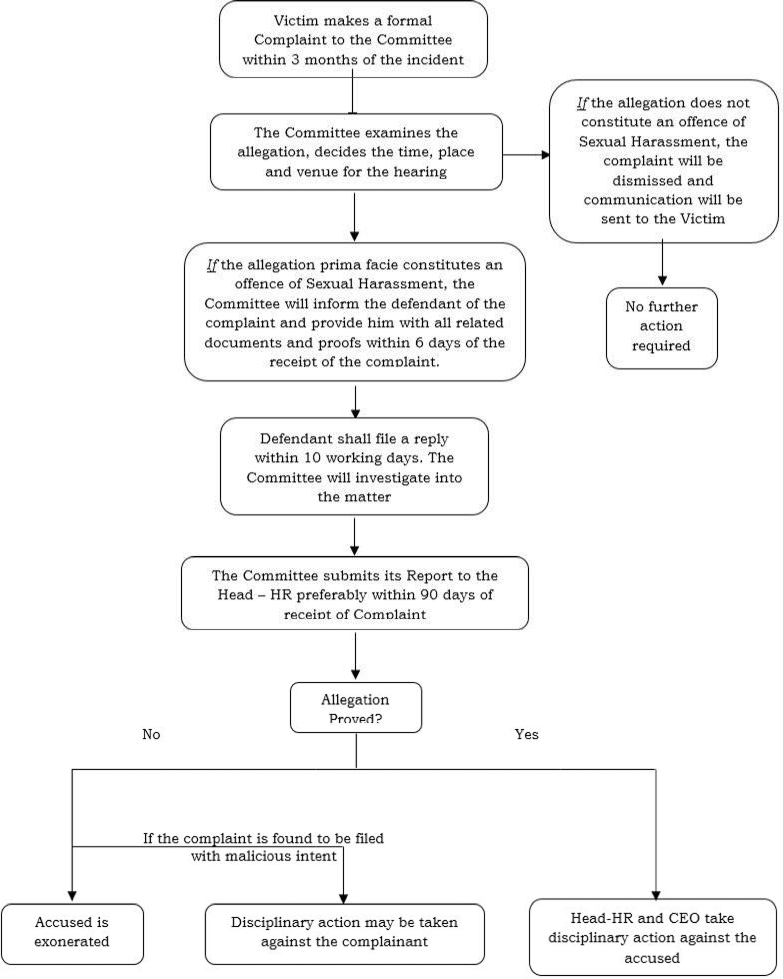
The process of inquiry will proceed in the following manner:
a) Communication: The IC will provide a copy of the Complaint (along with supporting documents) to the
Respondent within seven (7) working days.
b) Reply: Respondent will be asked to file a reply within ten (10) working days of receipt of the Complaint
along with list of documents, names and addresses of witnesses.
c) Investigation: IC shall investigate the matter of the Complaint in detail. The IC shall have the right to call
the Respondent or any other witnesses as and when necessary.
d) Quorum: A minimum of three (3) IC Members, including the Presiding Officer, must be present during
the inquiry.
e) Prohibition: During the inquiry process,the Complainant and the Respondent shall refrainfrom any form
of threat, intimidation or influencing of witnesses. The parties shall not be allowed to bring any legal
practitioner to represent them in their case at any stage of the proceedings before the IC.
f) Principles of Natural Justice: The IC will conduct the inquiry in accordance with the principles of natural
justice and will give both parties, the Complainant as well as the Respondent, an opportunity to be heard
before the IC.
g) Confidentiality: The IC shall ensure confidentiality during the inquiry process and will ensure that sufficient
care is taken to prevent any retaliation against the witnesses.
h) Ex-Parte Order: The IC will have the right to terminate the inquiry or take an ex-parte decision, if the
Respondent or the Complainant remains absent for 3 (three) consecutive hearings/meetings of the ICC,
without sufficient cause. However, such ex-parte decision shall not be made without providing a prior
written notice of 15 (fifteen) days to the Complainant or Respondent, as the case may be.
i) Deadline: The IC must complete its investigation within a period of 90 (ninety) days.
Annexure B lays down a pictorial representation of the Inquiry Process
8. Filing of Reports
The IC shall provide a report of its findings (“Investigation Report”) to the employer and the management
within a period of 10 (ten) days from the date of completion of the inquiry. The IC may also share the
Investigation Report with the parties after the completion of the inquiry.
Further, in each calendar year, the IC shall prepare a report (“Annual Report”) to be submitted to the
management and the district officer. The Annual Report will contain - (i) the total number of Complaints made
during a financial year; (ii) the total number of Complaints resolved/disposed of in accordance with this Policy;
(iii) the total number of Complaints pending for more than 90 (ninety) days; (iv) number of awareness programs
or workshops held; (v) and the nature of actions taken by the IC and/or the management.
Annexure C contains the format for the Investigation Report.
Annexure D contains the format for Annual Report.
9. General powers of the IC and power to take action
9.1 -
General Powers:
The IC while conducting an inquiry on a complaint by an “aggrieved woman”, may exercise
powers of a civil court in respect of:
a) Summoning and enforcing the attendance of any person and examining such person under oath; and
b) Requiring discovery and production of documents; and
c) Any other matter which may be prescribed.
9.2 -
Power to provide interim relief: During an inquiry, upon written request of the Complainant, the IC may:
a) Transfer the Complainant or the Respondent to any other workplace; provided that the Complainant tenders
justified reasons for such transfer, such as a threat inthe workplace;
b) Grant leave to the Complainant of up to 3 (three) months in addition to leave that the Complainant is otherwise
entitled to, provided that the Complainant tenders justified reasons for such leave, such as a threat in the
workplace.
9.3 -
Power to take further disciplinary action: If the IC arrives at the conclusion that the allegation against the
Respondent has been proved, it will recommend appropriate disciplinary action. This could range from:
a) Issuing a letter of warning that will be placed in the personal file of the Respondent for an offence that
is deemed minor by the IC;
b) Transfer or suspension without pay;
c) Dismissal of the Respondent;
d) Withholding of promotion;
e) Withholding of increments;
f) Asking the respondent to tender a written apology;
g) Asking the respondent to undergo counselling sessions or carry out community service;
h) Deducting fines from the salary of the Respondent for payment as compensation to the Complainant.
Such compensation shall be decided keeping in mind the following: the mental trauma, pain, suffering
and emotional distress caused to the Complainant; loss in career opportunity due to the incident of sexual
harassment; medical expenses incurred by the Complainant for any physical/psychiatric treatment;
income and financial status of the Respondent; and feasibility of such payment in lump sum or in
instalments;
i) Providing assistance to the Complainant, if he/she so desires, to lodge the Complaint with the
appropriate authority in case the Complaint is of a serious nature and punishable under the Indian Penal
Code, 1860.
9.4 - Power to take action in case of false or malicious complaints: In case a false Complaint is filed, and the investigation proves that the motivation of the Complainant was malicious, disciplinary action may be initiated against the Complainant, which may include dismissal from service. However, a mere inability to substantiate a complaint or provide adequate proof shall not attract action against the Complainant. Further, the Complainant’s malicious intent shall only be established after completion of the investigation in accordance with the procedure prescribed under this Policy.
9.5 Clarification: It is to be noted that this statement is not intended to discourage an aggrieved person from coming forward with any Complaints. The Firm recognises that some claims may be difficult to prove or support. These types of Complaints shall not be considered as false accusations.
10. Protection against retaliation
Regardless of the outcome of a Complaint made in good faith, the Complainant lodging the Complaint and any person providing information or any witness, will be protected from any form of retaliation. The IC shall ensure that the Complainant or the witnesses are not victimized by the Respondent. Any coercion, retaliation or any other type of unethical behaviour on part of the Respondent while the investigation is underway should be reported by the Complainant to the IC as soon as possible so that the IC may take appropriate disciplinary action.
11. Confidentiality
The contents of the Complaint made under the Policy, identity and addresses of the Complainant, Respondent and witnesses, any information relating to conciliation and inquiry proceedings, recommendations of the IC and the action taken by the Firm shall not be published, communicated or made known to the public, press and media in any manner. However, information may be disseminated regarding the justice secured to any victim of without disclosing the name, address, identity or any other particulars that may lead to the identification of the Complainant, Respondent and witnesses.
12. Preventive action
The Firm will strive to prevent sexual harassment at work by circulating applicable policies, displaying a notice containing names and contact numbers of the IC Members, displaying the penal consequences of sexual harassment, conducting awareness and sensitisation workshops and providing other relevant information to all employees.
Annexure A
Composition of Internal Complaints Committee
| Role | Name | Date of Appointment | Contact Details |
|---|---|---|---|
| Presiding Officer | Ms. Rutuja Pol | 01.04.2022 |
rutuja@ikigailaw.com
+91-9881936876 |
| Member | Ms. Pallavi Sondhi | 12.06.2025 |
pallavi@ikigailaw.com
+91-9650621496 |
| Member | Mr. Vijayant Singh | 30.09.2020 |
vijayant@ikigailaw.com
+91-9818876557 |
| Member | Ms. Astha Srivastava | 01.07.2022 |
astha@ikigailaw.com
+91- 9538597040 |
| External Member | Ms. Navmallika Gupta | 20.09.2024 |
navmallika@counselquest.co.in
98992 45242 |
Annexure B
Inquiry Process
Annexure C
Format for Investigation Report
| S. NO. | Item | Details |
|---|---|---|
| 1 | Date of receipt of Complaint | |
| 2 | Name/Contact details of Complainant(s) | |
| 3 | Date/Location of incident | |
| 4 | Brief description of Complaint (can enclose the complaint document) | |
| 5 | Name/Contact details of Respondent(s) | |
| 6 | Investigating IC Member(s) | |
| 7 | Dates of investigation | |
| 8 | Documents referred/verified/enclosed/collected | |
| 9 | Analysis/ Observation of the IC | |
| 10 | Conclusion | |
| 11 | Recommendation |
Annexure D
Format for Annual Report
| S. NO. | Item | Details |
|---|---|---|
| 1 | Total number of Complaints received | |
| 2 | Total number of Complaints resolved/disposed of | |
| 3 | Total number of Complaints pending for more than 90 (ninety) days | |
| 4 | Number of awareness programs or workshops held | |
| 5 | Nature of actions taken by the IC and/or the management. |
Annexure E
Indicative list of conduct amounting to sexual harassment
Verbal Harassment
- Sexually suggestive comments or comments on physical attributes.
- Offensive language that insults or demeans an individual, using terms of endearment.
- Singing or humming vulgar songs.
- Requests for sexual favours, sexual advances, coerced acts of a sexual nature.
- Requests for dates or repeated pressure for social contact.
- Discussing sexual activities, sexual prowess or intruding on the privacy of an individual.
- Sexually coloured propositions, insults or threats.
- Offensive graffiti in the office premises.
Non-Verbal Harassment
- Offensive gestures, staring, leering or whistling with the intention to discomfort another.
- Uttering a word, making a gesture or exhibiting any object with the intention that such word, gesture,
- or object be heard or seen by another.
- Sounds, gestures, display of offensive books, pictures, cartoons, magazines, calendars or derogatory
- written materials at one’s workplace.
- Showing or mailing pornographic posters, Internet sites, cartoons, drawings.
- Suggestive letters, phone calls, SMSes, electronic instant messaging or e-mail messages.
Physical Harassment
- Physical contact or advances.
- Intentional touching of the body, e.g. hugs, kisses, brushing, fondling, pinching etc. that makes
- another uncomfortable.
- Any displays of affection that make others uncomfortable or are inappropriate at the workplace.
Emotional Harassment
- Demanding sexual favours in return for or with a promise of favourable performance appraisals,
- promotions, sustained employment and provision of employment.
- Implied or explicit detrimental treatment for refusal to provide sexual favours.
- Interference with the work or creating an intimidating or offensive or hostile work environment.
- Humiliating treatment likely to affect health or safety.