What are Virtual Currencies?
The concept of virtual currency is perhaps best understood by way of an example. Take Airline Miles, for example, also referred to as frequent flier miles–the more you travel with an airline, the more Airline Miles you accumulate. These can later be redeemed for more tickets. When you redeem your Airline Miles for tickets, you are using your Airline Miles as a mode of payment. Thus, Airline Miles are serving as a unit of value, are issued and controlled by a centralized authority (i.e. the concerned airline or consortium of airlines) and may be used only for specific purposes (i.e. to buy air tickets). Consequently, the airline can write its own rules for the use of the Airline Miles and it does not need to rely on a third party such as a bank to issue or transact in Airline Miles, simplifying the overall transaction and granting greater autonomy to the transacting parties.
Virtual Currencies work roughly on the same principles as Airline Miles but without the same limitations, i.e. virtual currencies are not controlled by any centralized authority and may be used to purchase any goods or services from any merchant who is willing to accept Virtual Currencies as a means of payment.
However, this raises concerns about the safety and authenticity of virtual currencies. Where Airline Miles are concerned there is a centralized authority maintaining, authenticating and validating all data regarding the generation and consumption of Airline Miles. In the absence of such a centralized authority, how do Virtual Currencies achieve the same results? The answer is by use of the blockchain technology that is the bedrock on which Virtual Currencies operate.
Blockchain
Blockchain is a distributed public digital ledger on which all transactions made using the virtual currency are recorded chronologically. For e.g. let us assume 10 units of a virtual currency called “Insta” are held by Tanya as of 01.01.2018. As she and other users use the 10 Insta, the digital ledger will reflect entries as under:
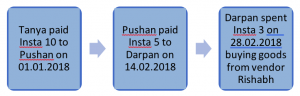
Hence as of 28.02.2018 of the original 10 Insta, Tanya has 0 Insta left, Pushan has 5 and Darpan has 2 and Rishabh has 3.
Each unit of Insta is thus accounted for and recorded on the digital ledger. However, this ledger is not maintained by any single person but is distributed and accessible publicly to anyone who wishes to be a part of Insta blockchain. Every such person (“node”) will have a copy of the Insta ledger on their system.
The moment any transaction is proposed to take place on the Insta blockchain each such node will get a notification. Each node will then see if the proposed transaction tallies with the previous ledger entry. If it does, the transaction will be validated. If a majority of the nodes validate the transaction, then such transaction will be recorded as a new block on the digital ledger, if not then it will be discarded. For instance, if on 28.02.2018 Pushan wants to give Tanya 3 Instas such a transaction will tally with previous record and is likely to be validated by a majority of the nodes and recorded as a new block on the Insta Blockchain. However, if on 28.02.2018 Tanya wants to buy 8 Insta worth of goods from Rishabh such a transaction will not be validated, as it may be seen from the records that as of 28.02.2018 Tanya has no Insta with her.
It is pertinent to note here that blockchain technology may be used to record the transfer of anything of value and not just the currency itself. For instance, blockchain may be used to record the financial transactions in fiat currency, transfer of digital entertainment content, land etc.
Thus, blockchain technology may be deployed to solve a number of real world problems such as helping migrant laborers remit money inwards, without using banks or other financial intermediaries, at a fraction of the costs.
Advantages of Blockchain
- Democratic and Robust: As blocks of information that are identical are stored across its network, the blockchain– (i) cannot be controlled by a single-party; (ii) lacks any single point of failure.
- Transparent and Incorruptible: The blockchain network lives in a state of consensus, one that automatically checks in with itself every few minutes. It is self-auditing in the sense that no new group of transactions (called a “block”) are added unless it is reconciled with a majority of the ledgers on the network. This, therefore, allows that (i) transparency is embedded in the technology as it is public by definition; (ii) It cannot be corrupted as altering any unit of information would mean altering all the ledgers on each computer on the network.
- Decentralized: Every node is an “administrator” of the blockchain, and joins the network of nodes voluntarily (in this sense, the network is decentralized). Nodes validate transactions on the blockchain in a process popularly known as “mining”.
Creation of Virtual Currency
Generally, nodes who are successful miners, i.e., nodes who successfully validate a transaction, and thus add a block to blockchain, are rewarded in terms of the virtual currency on which the said blockchain functions. For instance, nodes who successfully mine bitcoin are rewarded in terms of bitcoin that uses a pre-set mathematical algorithm to create new bitcoins for the successful miner. This is in principle similar to the stock options granted by early stage companies to incentivize employees of such companies that cannot afford to remunerate them in terms of money.
Valuation of Virtual Currencies
Virtual Currencies derive their value from mass adoption. That is, its price is a factor of its relative demand and supply – which ultimately is a reflection of its general level of acceptance. The utility or potential success of a virtual currency and its corresponding blockchain network therefore contributes to its value. In this sense it may be said that their value is driven by market sentiment in manner similar to valuation of stocks. Just as the value of a stock is dependent on the market perception of the company’s past performance and future potential, so is the value of virtual currency dependent on the market perception of its past performance and future potential.
[This post is authored by Tanya Dayal Sadana, Senior Associate, TRA].